
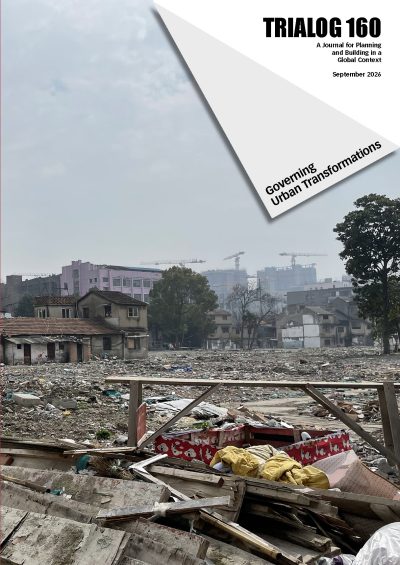
The interactions between society and state in shaping urban space, especially at the interface of the private and public domain in the Global South remain relevant for academics and practitioners. This issue collects contributions presented at the 21st N-AERUS Conference on “Transforming Role of State in Addressing Inclusive Urban Development” (October 2022) held by the Department of Sustainable Cities and Communities, at the University of Kassel in Germany, and the Urban and Rural Planning Discipline of Khulna University in Bangladesh, on behalf of Network-Association of European Researchers on Urbanisation in the South. Topics ranged from the global crises and local challenges to ideologies and policies as well as emerging agents, dynamics, and narratives within urban development. The papers presented here shed light on how socio-spatial inequalities are (re)produced through the interaction of different stakeholders engaged in the planning process, thus making visible the ambivalent role of the state in enabling urban development and searching strategies aiming at the public good. While neoliberal mechanisms remain present within planning processes, the authors explore how new narratives gain force, giving legitimacy to exclusionary and even violent urban processes that continue to shape the Global South. Furthermore, they highlight a wide range of intervention levels and their entwinements, which have a direct impact on people’s lives.
Hossain et al. investigate current discourse on climate change adaptation and resiliencerelated policies at national level in Bangladesh and the challenges in integrating them into local urban planning and city-making praxis. The authors show the difficulties of resolving structural inequalities within the existent frame of donor-based ad-hoc projects, highlighting the importance of micro-macro stakeholder collaboration.
Moving to a different political and geographical setup, and focusing on rural areas, Xiao’s work demonstrates emerging and changing actor networks and power relations within recent development-led rural land transfers in China. Direct and indirect resistance by marginalised groups can leveragepower and surpass the established and rigid hierarchies, such as those between the stateand villagers without land rights.
Rosen’s contribution highlights the social construct creating a conscious divide between formal and informal urbanisation, still persisting in planning practice. Investigating water and mobility infrastructures in Arequipa, Peru, the author introduces hybrid urbanisms as a way to investigate how formal and informal practices complement and interlink in basic infrastructure delivery.
Lastly, Banerjee et al. use the framework of biopolitics and hygienisation to analyse how pandemic governance at the time of COVID-19, forwarded urban policies that reproduced existing inequalities by destroying the innovative and incremental practices of survival in in Indian cities, such as the case in Mumbai.
On the one hand, contributions show the persistence of patterns of how urban territories are negotiated and occupied, observed in the interaction of inhabitants, institutions, and civil society, and made visible in scholarly work. We still detect spaces in-between, everlasting strategies in shaping the public space and infrastructure, permeability between the formal and the informal and continuous practices of self-help. On the other hand, new narratives such as the adaptation to climate change or ad hoc response to emerging threats such as the COVID-19 Pandemic give legitimacy to certain players, such as state representatives, donors and individual private actors to push their preferred urban development. In this context, we also observe how groups most affected also adapt, like villagers without land titles and intermediary actors evolve, such as professionalised civil society organizations.
Engaging with the scholarly work on how the state navigates inclusive urban development in the Global South, this special issue reiterates the timeliness of research focusing on the constantly evolving interaction among stakeholders involved in urban processes, continuities and ruptures. Together, it highlights the relevance of understanding how affected groups and communities respond and adapt to those. We continue to observe, learn, accumulate and share knowledge with the expectation of a just urbanization to emerge.
Inhalt
- 2. Editorial Lorena Melgaço and Umut Kienast-Duyar
- 4-14. A Comprehensive Approach to Combine the Roles of State and Donors in Building Climate-Resilience Strategies for the Urban Poor Md. Zakir Hossain, Md Mostafizur Rahman, Nur Mohammad Ha-Mim, Khan Rubayet Rahaman, Md. Abu Jobaer, and Salman F. Haque
- 15-26. Neoliberal urbanisation with Chinese characteristics? Actor networks and power relations in development-led rural land transfer Gaoli Xiao
- 27-35. Hybrid Urbanisms in Arequipa, Peru. Overcoming the Formal/Informal Bias in Infrastructure Delivery Christian Rosen
- 36-43. Pandemic Governmentality and Houselessness. Interrogating Management of COVID-19 through an Analysis of Dwelling Paroj Banerjee, Ratoola Kundu, Maggie Paul and Brijesh Arya
- 44-49. Hans Harms and TRIALOG. Four Decades of Writing on Self-Help Housing, Informality, and Urban Development. A summary of Hans Harms's contributions to TRIALOG, in memory of his work
- 50. Hans Harms (10 May 2031 – 10 April 2026)
- 51. Editorial deutsch Lorena Melgaço und Umut Kienast-Duyar