
While topics of decolonisation have long been discussed in Latin American, Asian, and African academia as part of long-standing independence movements (Escobar 1995; Fanon 1986; Said 1979), a growing body of urban studies and planning literature in the dominant English speaking discourse has challenged the predominance of theoretical, normative, and conceptual assumptions rooted in the Global North since the 2000s (Simone & Abouhani 2005; Roy 2005; Parnell et al. 2009; Robinson 2002; Watson 2009). Reflecting on place and power in urban theory, this literature has worked towards the postcolonial emancipation of cities from Northern representations.
Beyond this postcolonial urban critique, academics such as Mbembe & Nuttall (2004), Simone (2004, 2022), and/or Simone & Pieterse (2017) have sought to unsettle – from the South – the ontological grounds of urban knowledge production. Building on the intellectual work of decolonial thinkers and writers from colonised geographies, such as Fanon, Quijano, Chakrabarty, Spivak and Glissant, they work towards new Southern urban epistemologies that exceed conventional ways of seeing, learning, and making sense of urban space. For researchers from formerly colonised geographies, this literature helps describe and conceptualise the everyday engagement with lived realities of the South itself, which have made people question the exploratory power of Western-centric scholarship and theory in urban planning and the wider field of urban studies. Beyond this, such literature practically urges urban researchers, from all global spheres, to work towards a decolonisation of urban research and to re-examine dominant narratives, assumptions, and inherent power dynamics.
Thus, the entrenched global postcolonial structures, characterised by power inequalities that have grown and been reproduced historically, demand a critically reflexive research practice that imagines and works towards decolonial (research) futures. Thereby, the use of the concept of the ‚Global South vs. the Global North‘ can serve to describe inequalities, absences (Appelhans 2024), and unbalanced power-relations, although this bears the risk to simultaneously reproduce the fault lines along which colonial division was practised. Referring mostly, but not uniquely, to current post- and decolonial discourse in geography, urban planning, and urban studies (Ha 2014; Roy 2016; Winkler 2018; Lawhon & Truelove 2020; Schwarz & Streule 2020; Bauriedl & Carstensen-Egwuom 2023; Guma et al. 2023), this special issue addresses the very practical questions of research ethics, inclusion, and positionality in marginalised contexts. Particularly in marginalised contexts within the Global South, where power imbalances between researchers and research subjects are most evident, it is essential to reflect on one’s own positionality as a researcher, in addition to protecting the ‚researched‘ (Ha 2014; Lawhon & Truelove 2020). When researching the ‚marginalised‘, there is also a risk of reproducing stigmas through the inattentive selection of research sites and reliance on categories, such as ’slums‘, rooted in North-Western thoughts (Beier 2023; do Prado Valladares 2019).
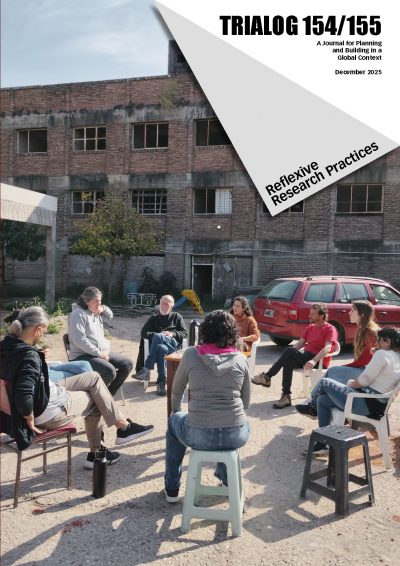
It is in this context that we, as the editorial team, have decided to compile a TRIALOG thematic issue that centres not on research content and results but, rather, focuses on presenting the negotiations around positionality as a researcher in the field.
Nadine Appelhans, Raffael Beier and Janek Becker
Inhalt
- 3-7. Introduction: Reflexive Research Practices in the Global South Nadine Appelhans, Raffael Beier and Janek Becker
- 8. A Tribute to a Dear Colleague and Friend - Obituary for Avhatakali Sithagu Florence Abugtane Avogo, Lucas-Andrés Elsner, Mfaniseni Fana Sihlongonyane, Andries du Toit
- 9-13. Power Relations in the Administration and Distribution of Customary Land Avhatakali Sithagu
- 14-22. Geographies of Experience. Trajectories, Practices, and Reflections on Territorial Research in the Amazon and Northeastern Brazil Claudio Ubiratan Gonçalves, Avelar Araújo Santos Junior and Fabiano de Oliveira Bringel
- 23-29. Informali-tales: Researching a Mirage Safiya El Ghmari
- 30-35. Towards Others, Towards Public. Reflecting on Public-Space Research in Johannesburg Temba Middelmann
- 36-41. Alikeness and 'the Other'. Making Sense of Postcolonial Conditions in Researching Marginalised Contexts Klaus Geiselhart
- 42-50. A Creative Partnership 10 Years On. How Filmmaking and Friendship Emerge from Amidst the Artefacts of Apartheid as a Tool towards More Just Urban Understanding and Co-production Kristen Kornienko and Thabang Nkwanyana
- 51. Bridging Structural Approaches and Lived Realities when Conducting Empirical Research in Morocco Meryem Belkadi
- 57-63. Reflections of a Technical Advisor/Researcher in the Case of the Slovo Park Informal Settlement Upgrade Project in Johannesburg, South Africa Neil Klug
- 64-68. Reproducing Racism – Between Shame and Reflexivity Manuel Dieterich
- 69-72. The Men Who Stare at Slopes. Reflections on Resilience and Knowledge Production in Marginalised Contexts Sebastian Purwins
- 73-80. The Need for Immersion in the Field. Confusions and Tensions during Fieldwork in Dominican Bateyes Julia Kieslinger and Stefan Kordel
- 81-89. Methodological Considerations for Decolonising Planning under Uncertainty. Vignettes from Exploratory Fieldwork in Peri-Urban South Asia Mrudhula Koshy
- 90-95. Reflections on research work at the interface of social struggles at urban peripheries and university Timo Bartholl